Bradley-Terry Rankings: Introduction to Logistic Regression

In a recent post, we identified the Colley Matrix methodology for ranking NBA teams. The methodology provided insight but abused the originating statistical construct in an effort to enforce a correlated, solvable, set of equations to identify a “probability” of winning. Unfortunately, we witnessed that not only were those statistical assumptions violated, but the resulting…

Statistics of Colley’s Ranking Methodology

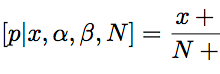
In 2002, Wes Colley (Princeton) developed a methodology that became a part of College Football BCS rankings lore: The Colley Method. In his original paper, Colley claims that his method is “bias free” for estimating the ranking of a team given a particular schedule. The resulting values for each team is identified as a ranking…

The Art of Sketching: Trajectory Analysis

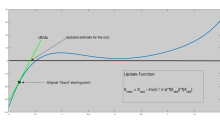
In a recent 2017 paper posted by Andrew Miller (Harvard University / Philadelphia 76ers) and Luke Bornn (Simon Fraser University / Sacramento Kings) titled “Possession Sketches: Mapping NBA Strategies,” the duo takes a well-known manifold learning technique called trajectory analysis and develops a methodology of classifying NBA actions through the use of functional mapping of…

Developing a Cross-Product Analytic: Kidd Score

In a recent podcast by Sixers Science, an analytic called the Kidd Score was unveiled. The goal of the analytic is to identify players who are great at two ancillary tasks: assists and rebounds. These two components are part of the big three statistical categories that make up the traditional triple double: points, rebounds, assists.…

Relationship Between TS% and eFG%

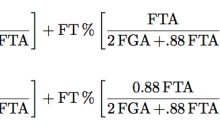
In an effort to understand shooting efficiency, terms such as points-per-possession, effective field goal percentage, and true shooting percentage have come about as methods to quantify scoring efficiency. In fact, during my coaching days in Baltimore City (2013 – 2016), I developed a metric called points responsible for (PRF) that focused on distributing points to…